

Organic banana production in Peru
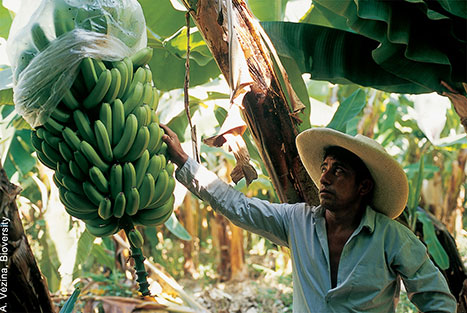
Almost all of Peru’s exported bananas are organic, representing approximately 3% of global organic banana production.
In 2014, organic banana production covered around 5,500 hectares, accounting for nearly 4% of the country’s total banana-growing area. Production was concentrated in the northern regions of Piura, Tumbes, and Lambayeque, primarily cultivated by smallholders with farms of less than three hectares. Since the late 1990s, when Peru began transitioning from conventional to organic farming, more than 80% of production has become concentrated in the Chira Valley in Piura 1.
- Between 2010 and 2015, organic banana production in Peru increased by 94% 2.
- Approximately 5% of Peru’s banana production is exported by nearly 7,000 small farmers.
- Between 2014 and 2015, exports grew by 19%, reaching USD 143 million and nearly 190,000 tonnes 3.
- Peruvian bananas are exported to 15 countries, with the United States as the primary destination, followed by the Netherlands, Germany, Belgium, South Korea, Finland, and Japan 4.
Factors influencing the development of organic banana production in Peru:
- Low levels of rainfall in growing areas, significantly reducing the need for investment in drainage.
- Low incidence of Black Sigatoka.
- Favorable tropical humid climate and weather conditions.
- Organization of small farmers into associations, improving competitiveness in international markets, strengthening bargaining power, and securing better prices.
- A beneficial tariff agreement between the EU and Latin America, in place since 2012, has boosted overall banana exports from Peru, leading to increased organic production.
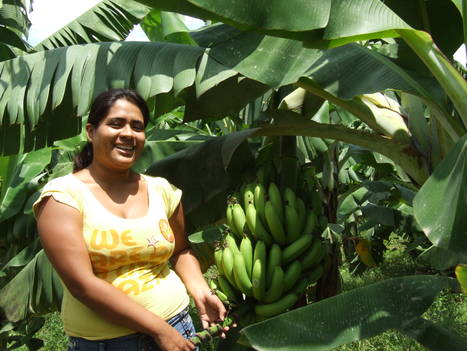
Example of Solidaridad 5
Solidaridad is an international non-profit organization with over 45 years of experience promoting sustainability in commodity supply chains. In Peru, it supports the organic banana sector through its fruit program, engaging key stakeholders to promote more efficient, resilient, and responsible agricultural practices.
As a key driver of Peru’s organic banana industry, Solidaridad has helped the first banana producers obtain certification, organize cooperatives, and strengthen their position in the market. The following organic production process has been successfully implemented on farms associated with Solidaridad in Peru.
The Process Step by Step
1. Field selection
- Fields should be located near an access route and a water source.
- A topographic plan is developed to properly position irrigation and drainage infrastructure.
- Before soil preparation, soil analysis and pit excavation should be conducted to study soil profiles.
2. Preparing the ground
- If the soil is compacted, a tractor-towed deep plow with 40 cm chisels should be used. A subsoiler may be necessary in extreme cases.
- Chisel plows help roots penetrate vertically, improving drought resistance, breaking compacted soil layers, and facilitating gas exchange.
3. Digging
- The soil should be moistened before digging a 0.40 m × 0.40 m × 0.40 m pit, considering the seed size. Superficial sowing affects plant production due to drought sensitivity. The top 30 cm of soil has the highest organic matter and nutrient content.
- Pits should be dug several days before planting to allow aeration and compost application. A mix of 1 kg of compost, 300 g of guano, and 100 g of Sul-Po-Mag is placed at the bottom to nourish the roots. Phosphate rock can be added if there is a phosphorus deficiency.
4. Selection of the seed
- Seeds must come from organically certified production centers. Plants should be pathogen-free, vigorous, and produce 12–13 commercial hands, with suckers measuring 1.5 m.
5. Extraction and selection of suckers
- Extraction is done when the soil is wet. Suckers with at least three functional sword-shaped leaves and a minimum height of 1 meter are selected.
- For large suckers or those transported long distances, the plant is cut 5–10 cm above the neck at an angle to allow drainage and prevent rot. Suckers are classified by size and planted accordingly; larger suckers reach harvest sooner.
6. Cleaning and washing of suckers
- Soil, roots, and pest-damaged parts of the corm are removed. The aerial portion is also cut.
- Severely damaged corms should be discarded. When cleaning, care must be taken not to damage the "crown buds" around the seed.
7. Disinfection of the seed
- Corms should be immersed in a solution of 5 ml of chlorine per liter of water for three minutes or soaked in water at 50–55°C for 20 minutes.
8. Seeding
- The seed should be placed upright in the pit, ensuring clusters develop in an orderly manner.
- Compacting the soil prevents seed rot by eliminating air pockets where water can accumulate.
Activity | Weeks after sowing |
|---|---|
Desuckering | 10 weeks (2.5 months) |
Elimination of relapses | 12 weeks (3 months) |
Sucker preselection | 14 weeks (3.5 months) |
Sucker selection | 20 weeks (5 months) |
9. Associated crops
- In new plantations, short-cycle crops, preferably legumes, should be planted to suppress weeds and reduce evaporation.
10. Irrigation
- Conducted every 15 days in summer and every 20 days in winter.
11. Weed control
- Done manually without chemical applications.
12. Fertilization
- Soil fertility analysis should be conducted before planting and repeated every two years.
- Foliar analysis should be conducted to assess nutrient uptake. Currently, fertilizers are applied three times a year (every four months). Common fertilizers include:
Fertilizer Application
Fertilizer | Ha/year | |
|---|---|---|
Sacs | Kg | |
Compost | 180 | 6,300 |
Potassium Sulfate | 15 | 750 |
Guano | 58 | 2,900 |
Kimelgran | 4 | 1 |
Sul-Po-Mag | 9 | 450 |
Total | 266 | 15,500 |
Nutrient Contribution
Fertilizer | N | P | K | Ca | Mg | S |
|---|---|---|---|---|---|---|
Compost | 75 | 24 | 15 | 0 | 0 | 0 |
Potassium Sulfate | 0 | 0 | 375 | 0 | 0 | 135 |
Guano | 348 | 203 | 58 | 232 | 14 | 43 |
Kimelgran | 0 | 1 | 2 | — | — | — |
Sul-Po-Mag | 0 | 0 | 99 | 0 | 81 | 99 |
Total | 424 | 227 | 551 | 233 | 97 | 277 |
13. Pest Control
- Implement integrated pest management. Apply organic repellents such as capsaicin-based compounds.
- Apply calcium polysulfide (caldo Sulfocalcico) to the plantation and soil.
- Use biological controllers like Orius insidiosus, which attacks thrips.
- Apply entomopathogenic fungi such as Beauveria bassiana and Lecanicillium in the afternoon and after stripping pods from pseudostems.
14. Control of Banana Streak Virus (BSV)
- Identify and eliminate affected plants.
- Replace infected plants with healthy suckers.
- Apply lime in the area where infected plants were removed.
- Ensure proper irrigation to reduce water stress.
- Reduce damage from other pests and diseases.
- Minimize weed competition.
- Improve plant nutrition to enhance physiological resistance to diseases.
- Remove dry pods to reduce cochinilla refuge areas.
15. Watery Rot Control
- Use healthy seeds.
- Ensure proper soil drainage.
- Disinfect tools regularly.
- Space plants adequately to allow ventilation and quick drying of foliage.
- Remove pods from pseudostems at the right time.
- Implement a fertilization plan based on soil analysis, ensuring adequate potassium and boron levels.
- Monitor the presence of weevils, particularly scratch weevils.
- During the wet season, cut pseudostems to prevent rainwater accumulation and bacterial spread.
- Prevent injuries that enable pathogen entry. Remove affected plants, sprinkle the hole with 2–3 kg of lime, and replant after three months with healthy seeds and compost.
16. Control of Crown Rot
- Cover cleaning tanks after filling them with water to prevent airborne spores from entering.
- Apply grapefruit extract (2–3 ml per liter of water) or alum (potassium aluminum sulfate, 400 g per 20 liters of water) via immersion.

Challenges
Organic banana producers in Peru face several challenges:
- Ensuring adequate nutrient supply, particularly nitrogen. Organic fertilizers with sufficiently high nitrogen levels are difficult to obtain.
- Securing a reliable supply of high-quality planting material. Many producers source planting material from their surroundings without assessing stem quality.
- Managing water resources for irrigation, as water availability is limited in Peru’s banana-producing regions.
- Accessing improved production technologies to enhance yields.
References
References
1 FIBL. Organic World statistics
2 Ministerio de Agricultura y Riego. 2015. Minagri: Exportación de Banano Orgánico Peruano Creció 94% en últimos 5 años
3 FreshPlaza. 2016. Peru: Organic Banana Exports Grow by 19%
4 FreshPlaza. 2016. Peru boosting organic banana production in Piura
5 Data from Solidaridad Peru