


Ethiopia

Agrifood policy monitoring
Overview of government spending on food and agriculture
Actual agriculture-specific expenditures* in Ethiopia from 2009–2021 stood at an average of USD 1.1 billion, with the lowest of the period being USD 783 million in 2009, the highest being around USD 1.7 billion in 2019.
In the last 5 years (2017–2021), budgeted amounts stood at an average of around USD 1.3 billion, while actual spending stood at around USD 1.5 billion, implying a budget execution rate of 112%.
Ethiopia’s agriculture expenditure progress declined over from 2009 to 2021 and was below the CAADP 10% target in the last five years. Between 2009 and 2021, the share of agriculture spending over total public expenditure ranged from the lowest 8.3% in 2018 and the highest 13.3% in 2010, with an annual average over the period of 10.3%.
Recently, over two-thirds (78%) of all expenditures on food agriculture came from the government, while the rest (22%) was financed by donors.
On average, in the same timeframe, 87% of actual agriculture-specific expenditures were directed towards the general support to the sector (i.e. public goods such as research, extension or infrastructure), and the reminder is spent in support of producers mainly in form of input subsidies.
Public expenditure on nutrition
The team is also carrying out a budget analysis with Policy Studies Institute to develop, test, and deploy a scalable approach to monitor public expenditure on nutrition as part of a policy reform negotiation process with national stakeholders. The focus is for policy change to make nutritious food more affordable in Ethiopia, while safeguarding livelihoods and ensuring agrifood systems deliver on other inclusive agricultural transformation outcomes such as increasing agrifood GDP, reducing poverty, and creating off-farm job in rural areas.
*in USD nominal terms
- Sorghum: producers experienced persistent disincentives over the period 2005–2024. On average, the NRP at the farm gate was –15 percent but improved to a more modest average of –7 percent between 2020 and 2024. This pattern is consistent with structural and policy constraints identified in Ethiopia’s sorghum value chain, including weak market integration, limited downstream demand, export restrictions, food aid inflows, and macroeconomic factors such as exchange‑rate overvaluation. The recent development of a National Sorghum Flagship Programme reflects growing policy recognition of these challenges.
- Teff: producers experienced a pronounced shift from negative to strongly positive price incentives over the period 2005–2024. The NRP at the farm gate averaged –24 percent between 2005 and 2009 but turned positive in the subsequent period, averaging 27 percent between 2010 and 2014. Price incentives increased substantially thereafter, exceeding 100 percent on average between 2015 and 2024. This evolution is consistent with strong domestic demand driven by income growth and urbanization that continues to outpace domestic production.
- Wheat: producers also experienced a transition from negative to positive price incentives over the period under review. The average farm‑gate NRP was –19 percent between 2005 and 2009, turning slightly positive (5 percent) during 2010–2014. Incentives strengthened further to an average of 31 percent between 2015 and 2019, before moderating to 14 percent in the period 2020–2024. This trajectory aligns with Ethiopia’s wheat self‑sufficiency strategy, which has combined large‑scale public investment, expansion of irrigated production, and policy support to reduce import dependence and raise domestic producer prices.
- Maize: in contrast to teff and wheat, maize producers faced persistent and substantial negative price incentives throughout the period 2005–2024. The NRP at the farm gate averaged –55 percent in 2005–2009 and declined further to –68 percent in 2010–2014 and –73 percent in 2015–2019. Although the disincentive eased somewhat in recent years, it remained strongly negative at –58 percent on average between 2020 and 2024. This pattern reflects a combination of policy choices aimed at keeping staple food prices low for consumers, limited border protection, and structural constraints in domestic marketing systems.
- Sesame: producers experienced positive but fluctuating price incentives over the period 2005–2024. At the farm gate, the NRP declined from 22 percent in 2005–2009 to 1 percent in 2015–2019, before increasing slightly to 3 percent in 2020–2024. At the point of competition, price incentives were consistently higher, ranging from 15 percent in 2005–2009 to 42 percent in 2010–2014, and averaging 21 percent in 2020–2024. These patterns reflect sesame’s strong export orientation, exposure to international markets, and the role of marketing costs and margins along the value chain.
- Coffee: producers and traders experienced highly variable price incentives over the period 2005–2024, mirroring volatility in international coffee prices, strong domestic demand, and shifts in marketing and export policies. For producers, NRPs ranged from –30 percent in 2005 to 55 percent in 2016, while trader incentives ranged from –30 percent in 2023 to 54 percent in 2017. In the most recent period (2020–2024), both producers and traders faced slight disincentives on average, at –1 percent and –6 percent respectively, underscoring the sensitivity of coffee price incentives to global market conditions and domestic policy settings.
Current support on agrifood policy
At the request of the Ministry of Agriculture, the MAFAP programme conducted a comprehensive assessment of the key constraints limiting the performance of the sorghum sector. Using price incentive indicators and analysis, the study generated evidence on sorghum producer incentives and identified priority policy interventions and investments to strengthen the sector.
Read the policy-analysis report on this: Analysis of price incentives for sorghum and other cereals in Ethiopia 2005–2024.
The report’s findings have informed the design of the forthcoming National Sorghum Flagship Programme (spring 2026).
Agrifood policy prioritization
MAFAP has been working with the Ministry of Agriculture and the Ministry of Planning and Development to present several spending and investment scenarios that would raise agrifood GDP, reduce poverty reduction, and create more off-farm jobs.
MAFAP is working alongside the FAO’s Food and Nutrition Division and the Ethiopian Public Health Institute on the Value-Added Impact Area (VAIA) initiative to calculate the least-cost healthy diets for Ethiopian subnational groups.
The MAFAP team used the calculations and data to carry out a policy analysis to better understand how to optimize public expenditure on food and agriculture in order to increase access to healthy diets for millions for Ethiopians.
Agrifood policy reform
The MAFAP programme has supported Ethiopia to bring about a policy reform on Agro-Commmodity Procurement Zones (ACPZ).
We carried out an investment gap analysis for Ethiopia’s Agro-Commmodity Procurement Zones (ACPZ), outlining investments and value chains with the highest rates of return, such as irrigation for wheat, and rural and feeder roads to improve productivity of milk and red meat.
News

MAFAP team highlights price incentives and public expenditure analysis at regional exchange on decoupling agriculture from deforestation in Africa
03/03/2026

Zewdu Dechasa joins MAFAP as Ethiopia focal point
11/02/2025
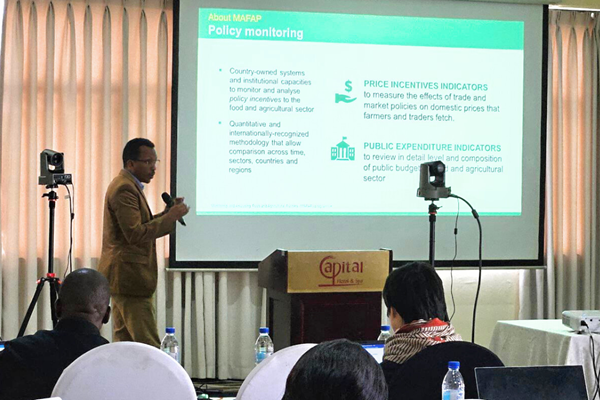
MAFAP presents its policy monitoring work at African Economic Research Consortium
24/05/2024
Publications

Analysis of price incentives for sorghum and other cereals in Ethiopia 2005–2024
18/02/2026
This report, requested by Ethiopia’s Ministry of Agriculture, will inform the forthcoming National Sorghum Flagship Programme. Sorghum is a key crop...

Boosting agrifood trade competitiveness – How an Agrifood Competitiveness and Trade (ACT) analysis can support countries in unlocking the potential of agrifood imports and exports
28/11/2025
The brochure presents the Agrifood Competitiveness and Trade (ACT) analysis as a tool for countries to pinpoint agrifood products with high potential...

Spending smarter on food and agriculture – Making public spending more effective with FAO's Policy Optimization Tool (PolOpT). Second Edition, 2025
17/10/2025
This is the new, second edition brochure on FAO's Policy Optimization Tool (PolOpT) updated in 2025.
Latest analysis on Ethiopia
Analysis of price incentives for sorghum and other cereals in Ethiopia 2005–2024
18/02/2026
This report, requested by Ethiopia’s Ministry of Agriculture, will inform the forthcoming National Sorghum Flagship Programme. Sorghum is a key crop...

Analysis of nutrition-sensitive public expenditure in Ethiopia's agrifood sector to enable healthy diets
20/05/2025
This study aims to provide an analysis of nutrition-sensitive public expenditure in the food and agriculture sector in Ethiopia, to inform and support...
Contact the Ethiopia team

Zewdu Dechasa
Policy Analyst
National partners
- Ministry of Agriculture
- Ministry of Finance
- Ministry of Planning and Development
- Agricultural Transformation Agency
- Policy Studies Institute
Useful links
- FAO in Ethiopia
- FAO Agrifood Economics and Policy Division
- Gates Foundation: Agricultural Development
